

The thinking behind the Future Proof Operating System
Owning a business means living at several altitudes at once. One day, you are worried about margins. The next, you are dealing with a leadership issue. Then an acquisition opportunity appears, or someone tells you it might be a great time to sell.
None of those conversations is necessarily wrong. The harder problem is knowing which one matters most, and whether the decisions you are making today are moving you toward the business and life you actually want.
The Future Proof Operating System is the framework we use with business owners to connect those daily decisions to a larger ambition.
It helps answer four questions:
- What are you building toward?
- What kind of work does the business need now?
- Which moves will create the most value?
- And how will you keep making progress when the urgent takes over?
Four connected components help us answer them:
- North Star
- Five Seasons
- Value Map
- Future Proof Rhythm
They are not a sequence you complete once. Together, they help you set a direction, focus your efforts, and adjust as things change.
The goal is to build a stronger, more valuable business that gives you more choices over time. You may want to sell, recapitalize, step away, transition the business to the next generation, or keep owning it. Enterprise value matters because optionality matters.
1. North Star: What are you building toward?
For one owner, the destination might be a $100 million sale. For another, it might be building enough leadership depth to step away from day-to-day operations, or owning a highly profitable company for decades.
We call that your North Star.

It brings your personal aspirations and business goals into the same conversation. Our North Star Worksheet helps you define that larger ambition before making choices about growth, finances, and what comes next.
The point is not to lock you into an outcome. Owners change, markets change, and life changes. A North Star makes the ambition explicit: if this goes really well, what are you trying to make possible?
Businesses have a remarkable ability to consume attention. A quarter falls behind. A major customer has a problem. Before long, the urgent crowds out the things that determine long-term value. The North Star keeps the destination in the room.
2. Five Seasons: What does the business need now?
Knowing your destination does not, by itself, tell you where to focus today. A company still heavily dependent on its owner has different needs from one with a strong leadership team, healthy margins, and a clear opportunity to accelerate growth.
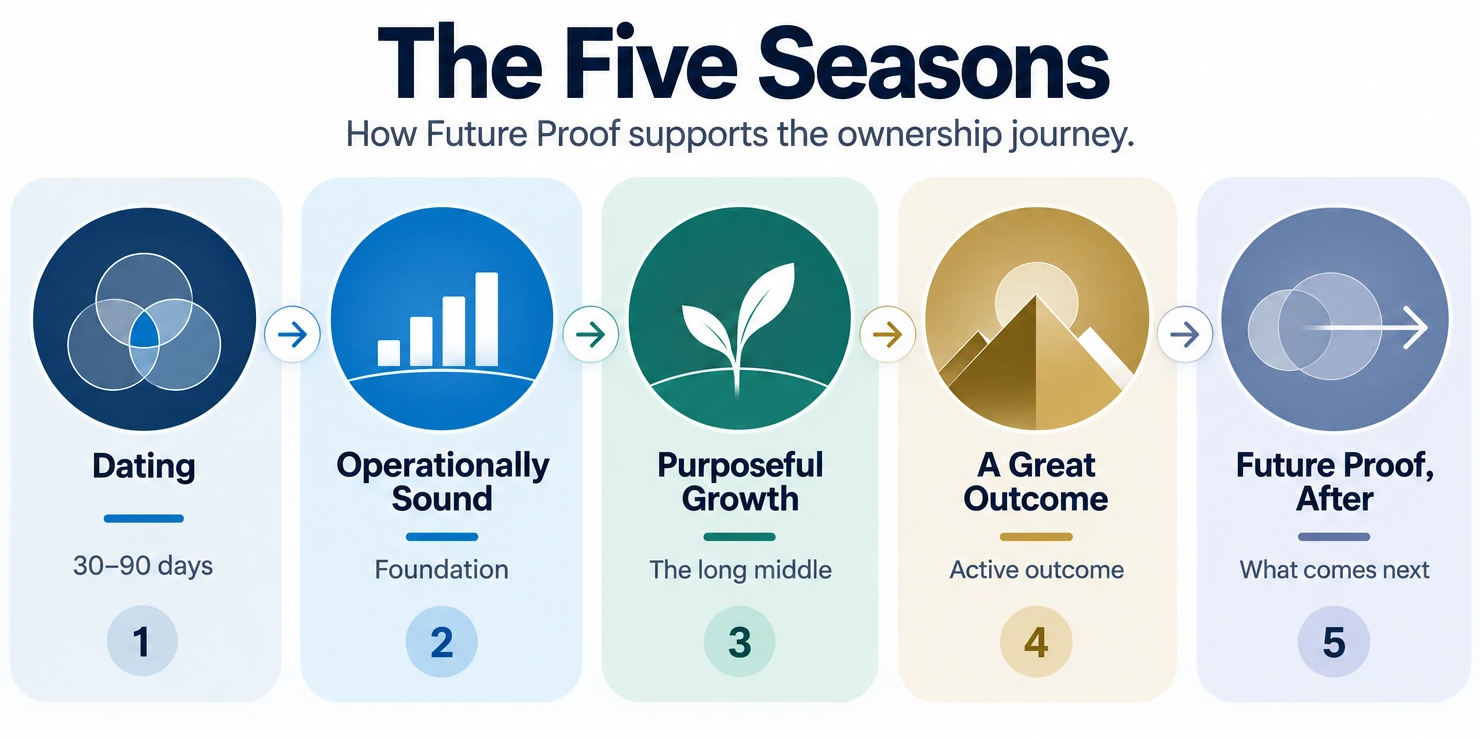
The Five Seasons name where a business is in its ownership journey and what kind of work deserves attention. They are not maturity grades or a rigid program. A company may spend months in one Season and years in another, or revisit earlier work. The point is to match priorities to the business in front of us.
Season 1: Dating
Dating is how we begin working together. We start with one or two real business problems, without asking for a heavy long-term commitment up front.
We learn how you make decisions and where the real issues are. You learn how we think and whether our involvement is useful. We begin defining your North Star and Strategic Initiatives, then decide together whether there is enough trust and fit to go deeper.
Season 2: Operationally Sound
Entrepreneurial companies can grow surprisingly large while carrying hidden fragility. Inconsistent margins, customer concentration, weak financial visibility, unclear accountability, or a business that still depends on the owner for every important decision.
Strengthening leadership, improving margins, and reducing concentration can make the foundation stronger and create more enterprise value than chasing another burst of revenue.
Season 3: Purposeful Growth
More revenue does not automatically create a better business. Growth can compress margins, add complexity, or make the company even more dependent on you.
Here we ask where to deliberately create value. That might mean entering a market, acquiring a company, strengthening positioning, or using technology to change the economics of the business. The aim is growth that makes the company stronger and moves it toward your North Star.
Season 4: A Great Outcome
At some point, the work should create a meaningful outcome for the owner. Selling is one possibility, but so are recapitalizing, transitioning ownership to family or management, combining with another business, or continuing to own a company you no longer have to run every day.
The earlier Seasons build the value and strategic strength to give you meaningful choices when the time comes.
Season 5: Future Proof, After
We know, we know, there are only four seasons. But after spending decades building a business, what comes next deserves a season of its own. You may invest, acquire another company, join boards, mentor entrepreneurs, or explore ideas you never had time to pursue. Deciding what comes next can be its own challenge.
3. Value Map: Which moves will create the most value?
With a North Star in view and a sense of what the business needs now, the question becomes more concrete:
What would have to become true to get from here to there?
Imagine your business is worth $60 million today and you want to build toward $100 million. EBITDA may need to rise, customer concentration to fall, recurring revenue to grow, and a leadership team to emerge that can run the company without you.
The Future Proof Value Map brings that thinking onto one page. It is a perceptual map of where the business is today, where you want it to go, the major steps required to get there, and an approximation of the enterprise value those steps could create.
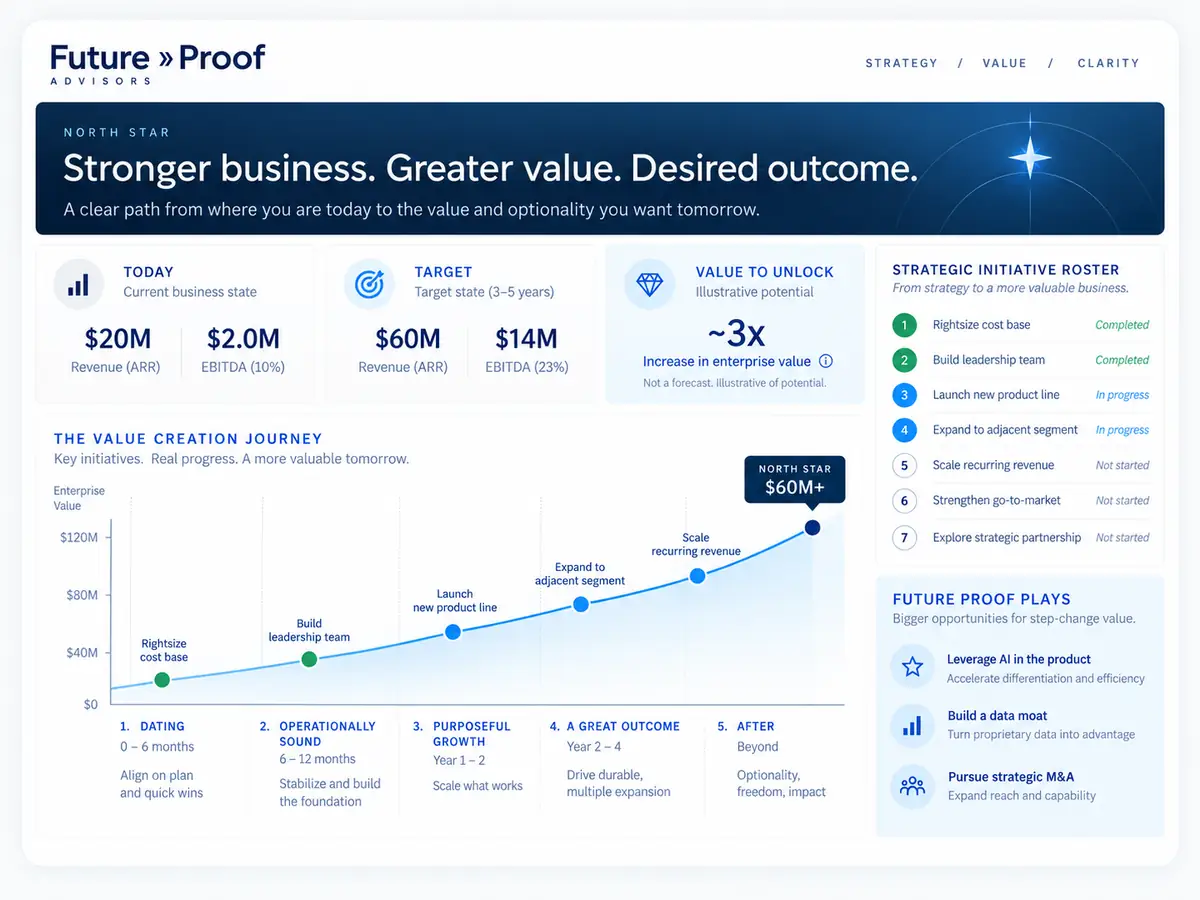
Most business plans are scattered across models, decks, meeting notes, and the owner’s head. The Value Map brings the essential pieces together and sharpens the discussion.
How much would concentration need to fall? Which Strategic Initiatives could materially change the quality of the business?
We put an approximate value hypothesis against the major moves to help prioritize them. These are directional estimates, not a valuation forecast. The practical question is whether we are spending our time on the changes most likely to strengthen the company and expand the owner’s options.
4. Future Proof Rhythm: How do we keep making progress?
Even a good plan loses its value if everyone returns to work and never looks at it again. The Future Proof Rhythm creates recurring space to act, step back, and adjust.
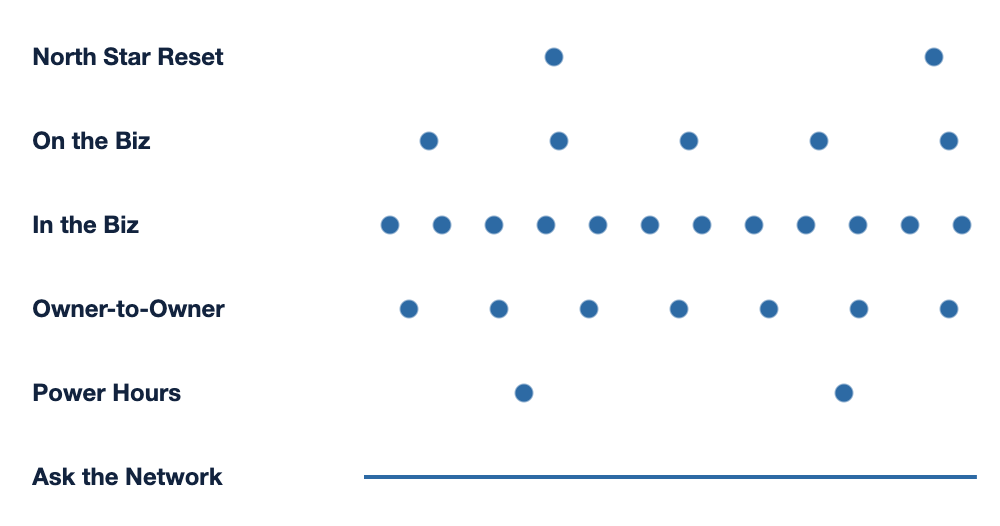
In the Biz keeps us close to execution. Progress, problems, decisions, and the immediate work required to keep the business moving.
On the Biz creates space to rise above that activity, return to the Value Map and ask whether the work receiving the most attention is still the work most likely to create value.
Periodically, we go higher still and reconnect with the North Star.
Do you still want what you said you wanted? Has something changed in the market, the business, or your own ambitions? Does the business now need a different kind of work?
The exact cadence can flex. What matters is keeping the plan connected to reality as the business and your ambitions change.
Being Future Proof means building a business strong enough to create the outcomes you want and the freedom to choose among them.